
Mark and Focus analysis
A Credible Rangeland Standard Must Protect Rights as Well as Restore Land
Read the analysis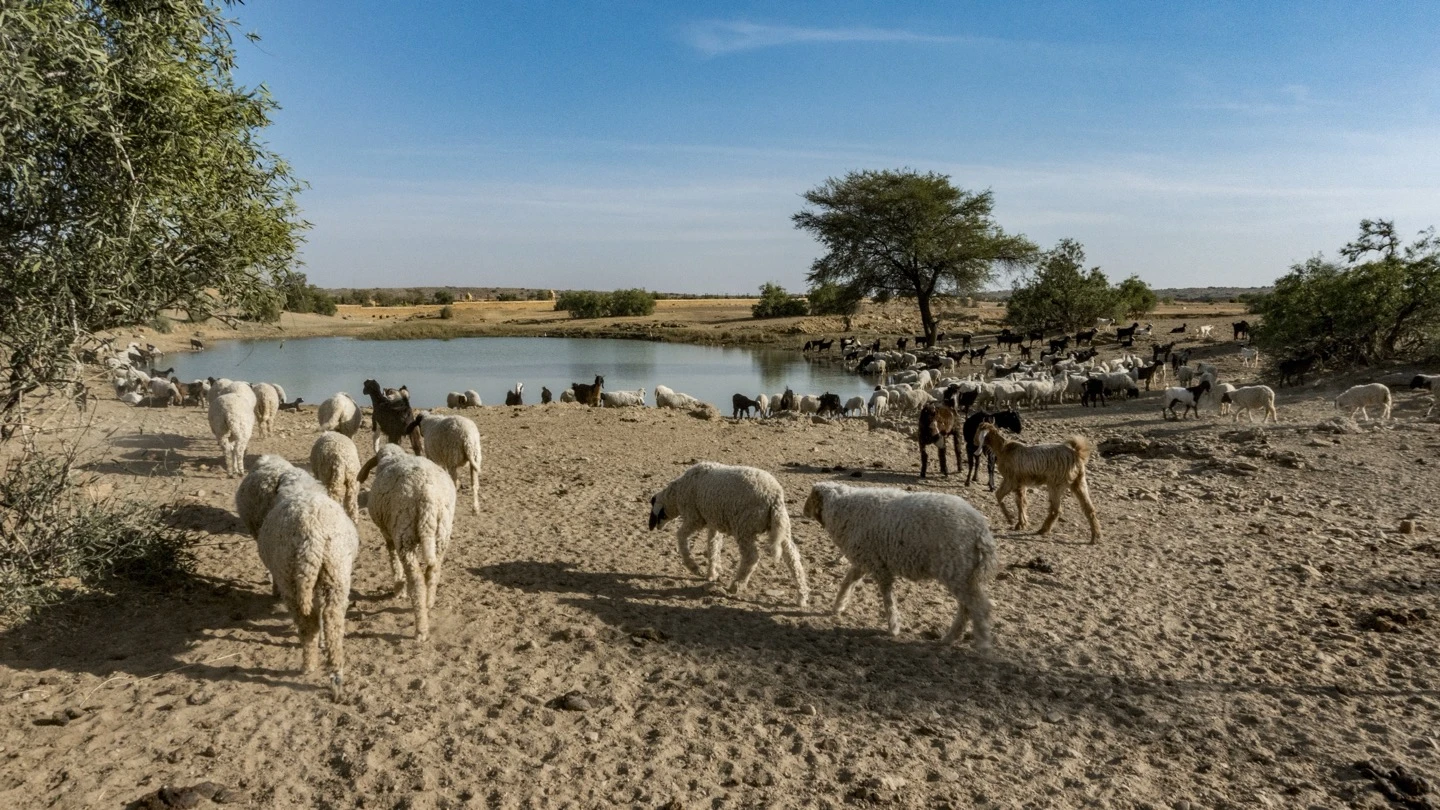
India’s COP17 position places community stewardship and secure tenure alongside ecological restoration. A credible rangeland standard must measure open ecosystems properly, protect seasonal access, support adaptive grazing and finance durable local governance.
India used the UN Convention to Combat Desertification’s COP17 to argue for community-led rangeland restoration grounded in science, secure tenure and local stewardship. The proposition is important because rangelands are easily governed as empty or degraded space even when they are working landscapes with mobile users, seasonal rules and ecological functions that conventional land categories fail to record.
UNCCD estimates that rangelands cover more than half of the Earth’s land surface and that roughly half are degraded. India brings exceptional variety to the question: Himalayan pastures, central savannas, the Thar Desert, Kachchh grasslands and southern shola systems. It also brings an unresolved institutional challenge. Restoration must improve vegetation, soils and water without erasing pastoral access or converting diverse rangelands into administratively convenient plantations.
A credible rangeland standard therefore needs several distinct tests.
1. Ecological condition must be measured as a rangeland, not as failed forest
Rangelands do not become healthy by maximising tree cover. Many are naturally open ecosystems. Their condition depends on plant composition, ground cover, soil stability, water infiltration, grazing pressure, fire regimes and the movement of animals across seasons.
India’s statement highlighted deep-rooted grasses as contributors to soil carbon, infiltration and groundwater recharge across an estimated 10 million hectares of permanent pasture and grazing land. These functions are material, but they are not captured by a single measure of green cover.
A standard should require a locally appropriate ecological baseline and a basket of indicators: native grass and forb diversity, bare-ground patterns, erosion, soil organic carbon, infiltration, invasive species, water-point condition and habitat connectivity. Remote sensing is useful for scale and change detection; field evidence is necessary to distinguish productive seasonal variability from degradation.
India’s desertification and land-degradation atlases can guide priority-setting, but classification should not predetermine the remedy. A remotely observed decline in vegetation may reflect drought, altered mobility, invasive species, fencing or excessive grazing. Each requires a different response.
2. Tenure must include movement and seasonal access
Secure tenure is not limited to an individual title over a fixed parcel. Pastoral systems often depend on shared grazing areas, migration corridors, water points, fallow access and negotiated seasonal use.
India’s Forest Rights Act recognises grazing, access to water bodies and traditional seasonal resource access for pastoral and nomadic communities. It also recognises community rights to protect, regenerate, conserve or manage forest resources. Those provisions supply a legal foundation, but recognition on paper does not automatically protect a route from enclosure, infrastructure, conflicting land allocation or administrative reclassification.
A restoration programme should therefore map users and seasonal patterns before defining its boundary. It should record who can authorise changes, how competing claims will be resolved, and whether restoration works obstruct mobility. Consent is not a single meeting. It is a governance process capable of representing women, mobile groups and users who may be absent during part of the year.
The minimum tenure test is practical: after restoration, can legitimate users still reach the grass, water and seasonal routes on which the system depends?
3. Grazing management must be adaptive, not simply restrictive
Degradation can result from sustained pressure beyond a landscape’s capacity. Yet excluding livestock is not always restoration. Grazing can influence plant competition, nutrient cycling, fuel loads and habitat structure. The relevant question is where, when, for how long and under what conditions animals graze.
Community institutions can hold knowledge that a central plan lacks: the condition of distant pastures, the reliability of water points, the timing of forage emergence and the agreements needed to rest particular areas. That knowledge should inform an adaptive grazing plan with explicit triggers for drought and recovery.
The plan should be revisable. A fixed stocking rule may fail when rainfall varies sharply. Monitoring should allow communities and technical agencies to alter access periods, rotation, supplementary fodder and restoration measures. Where restrictions impose real livelihood costs, the programme needs a credible compensation or alternative-fodder mechanism. Otherwise compliance will depend on households absorbing a public ecological cost.
4. Water interventions must be judged across the landscape
Rangeland restoration is often hydrological. Contour works, check structures, grass recovery and soil protection can slow runoff and improve infiltration. Poorly placed water points, however, can concentrate animals and degrade surrounding land. New structures can also redirect flows away from downstream users or habitats.
A standard should therefore evaluate the water balance beyond the project site. It should examine whether erosion is displaced, whether recharge claims are measured, how water-point density affects grazing distribution, and who maintains structures after external funding ends.
The correct unit is often a watershed or migration landscape rather than an administrative plot.
5. Finance must reward durable stewardship
India called for finance, technology, knowledge exchange and South–South cooperation. Those resources are needed, but UNCCD’s own recent rangeland work warns that investment can fail without rights, community institutions and inclusive governance.
Short project cycles are especially poorly matched to rangelands. Ecological outcomes vary with rainfall; institutions need time to negotiate rules; benefits may appear outside the funded boundary. Payments based only on planted hectares or structures completed can reward activity without proving recovery.
Finance should instead cover baseline work, community governance, long-term monitoring, livelihood transition where necessary, and maintenance. Performance payments can include ecological improvement, but they should not transfer climate and rainfall risk entirely to communities. Public funding is also justified where restoration produces downstream benefits — lower sediment loads, improved infiltration, biodiversity or reduced dust — that local users cannot monetise.
What the standard should prevent
The most useful standard is partly a safeguard against false restoration. It should prevent natural grasslands from being treated as vacant land; prevent plantation targets from displacing open-ecosystem biodiversity; prevent mapped project boundaries from severing mobile access; prevent water infrastructure from concentrating degradation; and prevent communities from being described as participants while decisions remain external.
India’s COP17 position is credible because it joins ecological evidence with tenure and stewardship. Its value will depend on whether programmes translate that principle into enforceable practice. Rangeland restoration succeeds when the landscape can continue to function ecologically and socially. A greener satellite image is not enough if it records the loss of the people and movements that maintained the system.
Take-Out
Rangeland restoration is credible only when ecological recovery strengthens rather than displaces the tenure, mobility and community institutions that allow pastoral landscapes to function.
Questions and answers
What readers should know
- Why should rangelands not be assessed as failed forests?
- Many rangelands are naturally open ecosystems. Tree-cover targets can damage grassland biodiversity and obscure indicators such as native grasses, soil stability, infiltration and seasonal condition.
- What does secure tenure mean for pastoral communities?
- It can include shared grazing areas, seasonal routes, water points and negotiated access, not only an individual title over a fixed parcel.
- Does restoration require livestock exclusion?
- Not automatically. Grazing effects depend on timing, duration, intensity and ecological condition, so adaptive management may be more appropriate than blanket exclusion.
- Why must water interventions be assessed beyond the project site?
- New structures and water points can alter runoff, recharge, animal concentration and downstream access, shifting degradation rather than resolving it.
- What should restoration finance pay for?
- It should support baselines, community governance, long-term monitoring, maintenance and livelihood transition where restrictions impose real costs, not only planted hectares or completed structures.
Stay in the loop
Keep Mark and Focus in view
Hear about future publications, announcements, and relevant updates from Mark and Focus.