
Mark and Focus analysis
Indonesia’s 100 GWp Solar Launch Turns an Energy Target Into a Delivery Map
Read the analysis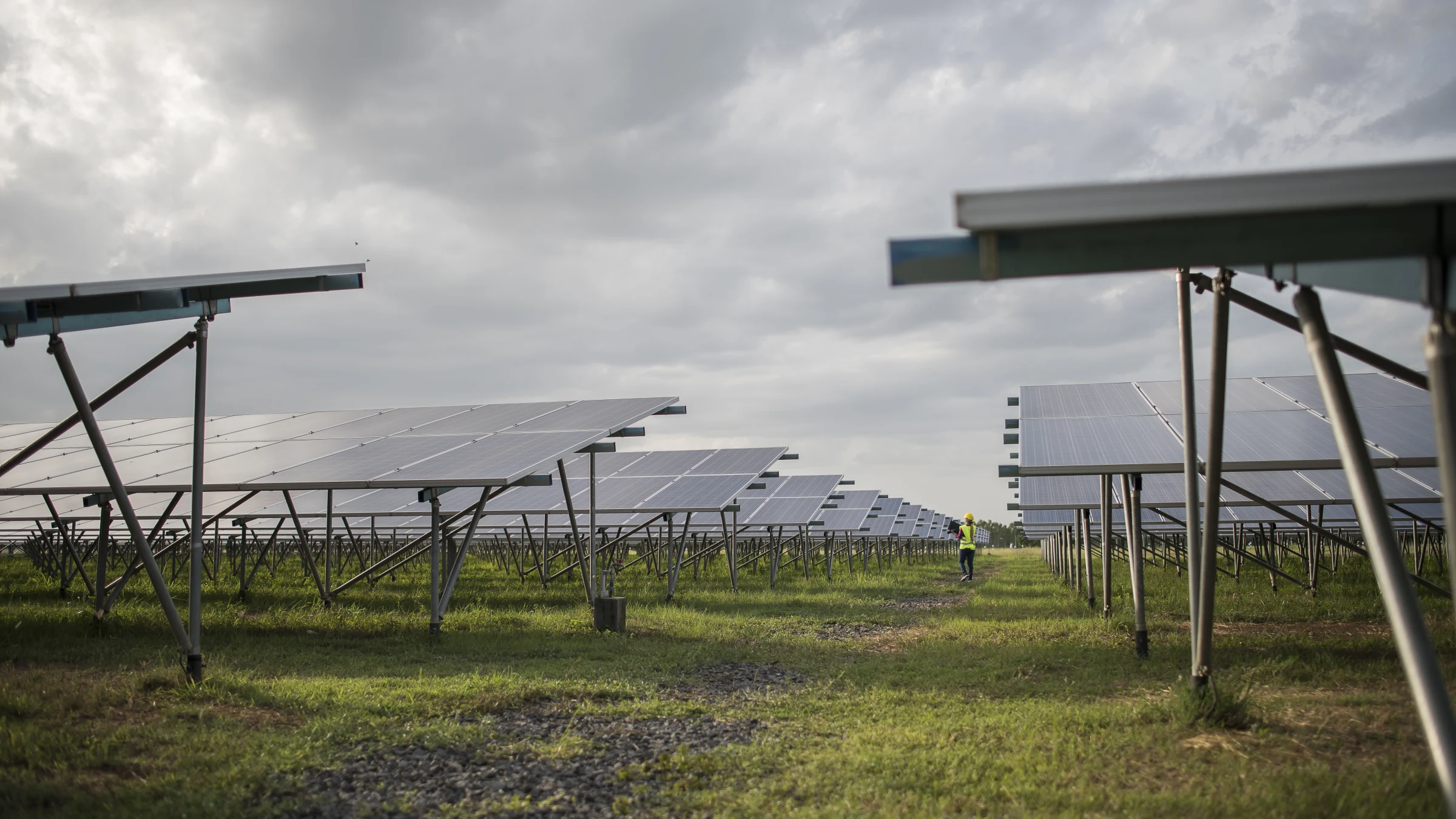
Indonesia has launched a 100 GWp solar program with 14 initial projects totaling about 5.3 GWp. Its credibility now rests on translating very different sites into financeable, connected, maintainable electricity services.
Indonesia has moved its 100 gigawatt-peak solar ambition from a national target to an initial construction portfolio. On 25 August, the government launched the program and broke ground at Gilimanuk in Bali, connecting the event with projects at the Gajah Mungkur reservoir in Central Java, Sembur village in the Riau Islands, and Rengit Island in Bangka Belitung.
The first phase contains 14 projects across six provinces with combined capacity of about 5.3 GWp. That is a serious opening tranche, but it is still only the beginning of a program that the president says should reach 100 GWp within three years. The gap between those numbers defines the real story. Indonesia is not simply building a large solar farm. It is attempting to create a delivery model that can work across utility-scale sites, reservoirs, villages, islands, industrial supply chains, and very different electricity networks.
Four projects, four operating problems
The launch grouped together projects that share a technology but not an operating context. Gilimanuk is planned at 300 MWp. The floating installation at Gajah Mungkur is listed at 134 MWp. Sembur’s 0.92 MWp system is tied to a five-ton cold-storage facility and a four-ton ice machine used by fishing communities. Rengit’s 0.078 MWp system is reported to have extended electricity availability from roughly 12 hours to 24 hours a day.
Those differences matter more than a single national capacity total. A utility-scale plant must secure land or water rights, grid connection, dispatch arrangements, and long-term maintenance. A village or island system must match generation and storage to a much smaller load, maintain equipment far from major service centers, and protect essential uses when weather or components fail. A system serving cold storage has a direct productive purpose: unreliable power can spoil inventory and interrupt income.
The first 14 projects should therefore be treated as an operating portfolio. The government can learn which contracting, connection, storage, maintenance, and community arrangements survive across different settings. Replication should follow proven configurations rather than assume that one design can simply be multiplied until the national total reaches 100 GWp.
Storage and networks decide how much solar becomes useful
Nameplate solar capacity does not by itself replace diesel or guarantee continuous service. Output changes through the day and with cloud conditions. Electricity networks must absorb the power when it is available, while batteries or other flexible resources must bridge the mismatch between production and demand.
The government links the program to domestic solar-panel manufacturing and battery energy-storage systems. That industrial connection could reduce exposure to imported equipment and create a larger local service base. Yet domestic production only strengthens energy security if products meet performance standards, warranties can be enforced, replacement parts remain available, and installers and operators have the skills to keep systems working.
The same discipline applies to the government’s projected benefits. Officials estimate annual public-budget savings above Rp73 trillion, diesel savings of up to six million kiloliters, 5.52 million cumulative jobs, and annual emissions reductions of 140.16 million tonnes of carbon dioxide. These figures describe expected program effects. They are not measured outcomes from the projects launched in August. Each depends on build rate, actual generation, the electricity displaced, local content, equipment life, and how jobs are counted.
The first evidence should be operational
Indonesia will need a reporting structure that preserves the identity of each project. Capacity awarded, financed, under construction, connected, and reliably operating should not be collapsed into one total. For island and village systems, hours of service, outages, battery performance, maintenance response, diesel use, and productive demand will reveal whether access has improved. For larger projects, connection readiness, curtailment, construction progress, cost, and delivered output will matter.
That evidence would also clarify whether the three-year national target is an executable program or an aggregation of opportunities at very different stages. A credible delivery map should identify who owns each project, who buys the electricity, what network work is required, where storage sits, how equipment will be serviced, and which approvals still stand between an announced site and commercial operation.
Indonesia’s launch is significant because it starts with real sites rather than a capacity promise alone. Its strongest proof will not be another national total. It will be a set of projects that keep working in the places they were designed to serve, while creating a dependable route for the next tranche to follow.
Take-Out
Indonesia's solar ambition will be judged by whether its first 14 projects establish a repeatable route from panels and batteries to dependable local power, industrial capacity, and diesel displacement.
Questions and answers
What readers should know
- What was launched?
- A national 100 GWp solar program and an initial portfolio of 14 projects across six provinces totaling about 5.3 GWp.
- Why are the first projects analytically useful?
- They span utility-scale, floating, village, island, and productive-use applications, allowing delivery arrangements to be tested under different operating conditions.
- Does the launch prove that 100 GWp will be built within three years?
- No. It establishes a target and first tranche; finance, approvals, networks, storage, construction, and operations remain to be demonstrated at much larger scale.
- What should be measured first?
- Project-stage status, connected capacity, actual generation, service hours, outages, curtailment, battery performance, maintenance response, and verified diesel displacement.
- Why does domestic manufacturing matter?
- Local panel and battery production can strengthen supply security and skills, but only when product quality, warranties, spares, installation, and long-term service are dependable.
Stay in the loop
Keep Mark and Focus in view
Hear about future publications, announcements, and relevant updates from Mark and Focus.