
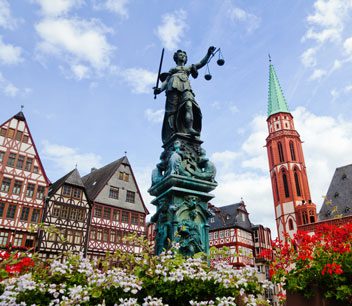
Frankfurt is one of the world’s leading green cities with: 52% of its space green; 160,000 trees lining its streets and spaces; and 40 parks and 50 lakes for recreation and outdoor enjoyment. One of the standout features – recognized by UN HABITAT II as a positive example of sustainable urban development – is the city’s GreenBelt that acts as a ‘green lung’.
Frankfurt’s GreenBelt
The GreenBelt’s 8,000 hectares cover a third of the city’s surface area and forms a belt 70 km long around Frankfurt. The GreenBelt is diverse in nature and ecosystems with its landscape including orchard meadows, natural conservation areas, streams, farmland, parks, gardens, sports and leisure areas. Its high quality nature and facilities ensures it is one of the Rhine-Main Region’s most popular leisure areas.
The GreenBelt’s municipal forest
One of the most impressive aspects of the GreenBelt is that it includes a municipal forest: one of the largest municipal woodland areas in Germany. The forest covers 6,000 hectares and is comprised of oak (34%), beech (31%), pine (29%) and spruce and Douglas pines (6%). The municipal forest enjoys legal protection having been designated a climate, emission and water conservation area. In addition, there is 4,600 hectares of recreational woodland that is comprised of around 420 km of routes through the forest including over 150 km of signposted cycling and hiking tracks as well as 96 km of routes for horse riders, providing the people of Frankfurt and the region numerous recreational opportunities.

Improving access to Frankfurt’s GreenBelt
Today, the city is aiming to improve access to the GreenBelt as well as enhance connections to inner-city green and open spaces as well as recreational areas in the region. Frankfurt has already started adding a new green link in the east of the city with the linking of Ostpark and the River Main. Previously this trip was considered unpleasant with car fumes and vehicle noise impacting the environment as well as the health and wellbeing of pedestrians and cyclists. As such, a ‘landscape gap’ was added with Deutsche Bahn allowing the green link to pass through its land including a former railway platform.
The take-out
Green spaces in and around cities provide habitats for wildlife, ecosystem services and numerous recreational opportunities for residents, enhancing overall quality of life.
*Robert C. Brears is the author of Urban Water Security (Wiley). Urban Water Security argues that, with climate change and rapid urbanization, cities need to transition from supply-side to demand-side management to achieve urban water security.


